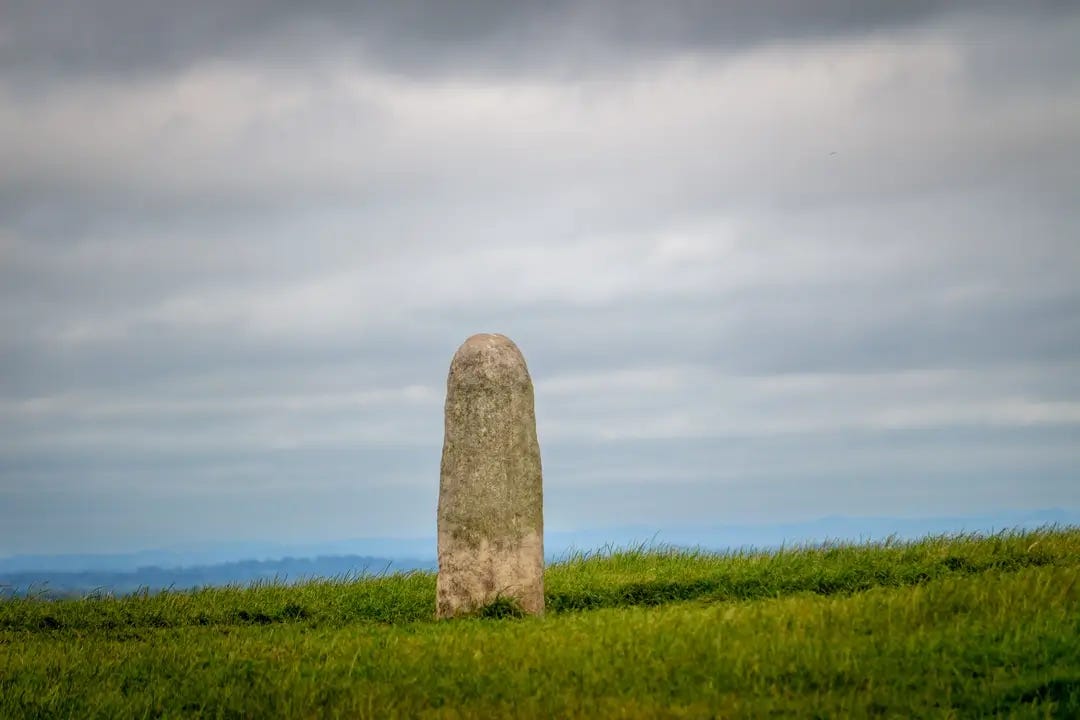
Invoking Moriarty
Lia Fáil - Part II

I would like to invite you into my soul in real-time.
I originally planned on writing part II after my trip to Ireland and my visit to the Fáil. I thought that it would make the most sense to cohere the story after the fact. But enough strangeness has arisen in the past few weeks to make me question the solidity of my Verständnis. I feel that answers to my Soul’s longing are beginning to emerge from the fog on the horizon – and I would like to tell you about that process.
In Part One I shared with you the nightmares of my childhood. I shared how those nightmares were biblical in proportion – going so far as to compare them to Job’s visions of Behemoth and Leviathan. Then I shared with you my discovery that the central object of my nightmares is a very real stone which resides at the Hill of Tara in Ireland – the Lia Fáil – the Shrieking stone. I shared a little of the history and folklore of the Stone – how The Sovereign Stone would Shriek in the presence of a true High King. I tried to share how this stone is a real object which inhabits my deepest mythic and psychic depths, and how I am both terrified and inexplicably drawn towards it.
I wrote Part one from as deep as I could go within myself – from a place where the pressures around me were crushing and where I could barely see the shadows of ancient giants swimming around me. It was my attempt to bring something to the surface.
The day after I posted Part 1, the book ‘Invoking Ireland’ by John Moriarty came in the mail. I began reading, and I was delightfully horrified to see that he had already written what I had - just much better.
Had I read this book online somewhere and forgotten? Was I poorly plagiarizing a greater man? Oh God - it would make much more sense if I was. Hearing my thoughts and experiences in Moriarty’s voice has brought me both peace and terror. Peace, for I feel less alone in my explorations of such a vast and dreadful mytho-ancestral mindscape. Terror, for now I know more fully that those nightmares are far more than just the bad dreams of a child.
I’m only halfway through ‘Invoking Ireland’ right now. I’ve never been this scared and excited to finish a book. I’m continuing to read it slowly; but in the meantime, I’d like to share some passages with you. These are not full chapters, and I highly encourage you to purchase your own copy from Lilliput Press – the full thing is much grander.
Go n-éirí an bóthar leat
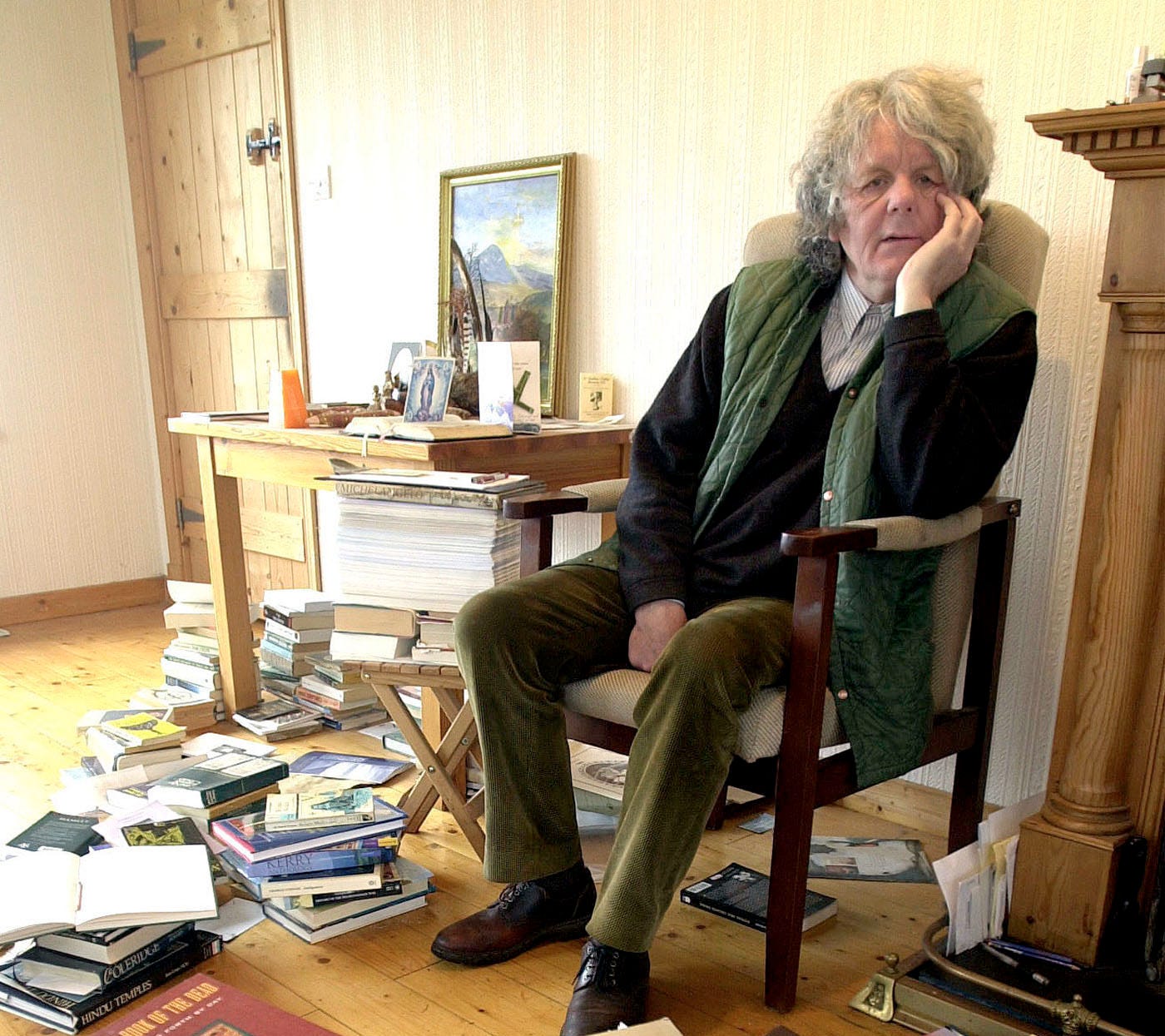
… To pagans it is the entrance to the Otherworld. To Christians, who avoid it, it is the hell-mouth, a way out for all kinds of terrors and horrors, all of them devilish.
This is the nineteenth year that I have lived in a hut beside it.
Sometimes, without my being able to do anything about it, it is a fissure inside my own mind. A fissure through which nightmares not mine emerge leaving me not able to see out through my eyes next day.
The second time he walked towards me in a dream my father looked dilapidatedly Christian. Always, he said, there must be someone who sits by the hell-mouth. Someone who is full humanity, suffering our nightmares. Else, no one would sleep. And that, quite soon, would be the end of us.
Who was he talking about, I wondered? Was he talking about me in my hell-mouth hut or was he talking about Jesus in Gethsemane?
To be the hell-mouth to humanity? To the Earth? To all things?
The very thought of it very nearly tripped me headlong back into Christianity.
So what, I asked myself, if Christianity doesn’t suit me?
A thin wind from the north on a night when I have no firewood, that doesn’t suit me. A fox killing my five laying hens on a day when I have nothing to eat, that doesn’t suit me. People avoiding me because I live as I do, that doesn’t suit me.How well, I asked myself, does my nature suit me? How well does my nightmaring mind suit me?
That something doesn’t suit me isn’t a good enough reason to walk away from it and this, I thought, is as true of Christianity as it is of my nature.
If I couldn’t be a Christian monk with Ciarán in Saighir could I be a Christian druid with the Sun and the Moon and the Earth and the Wind and the Rain here in Cruachan? Could I be a pagan Christian?
The wonder was that wolf and stag and fox and badger and boar had helped Ciarán to build his monastery. To him, they were his monks. That was why I went there, only in the end to see my father coming towards me.
It hardly matters now. But Christians are right in one thing.
At the dead of night, not dead here, Uaigh na gCat is a hell-mouth not an entrance to a marvellous Otherworld.It is not called Uaigh na gCat, the Cave of the Cats, for nothing.
Having as much ferocity as they need, having whatever shape and size they need, three Terrors, catlike in their stealth, will emerge and, just to prove to themselves that they can do it, they will leave people unable ever again to inhabit themselves.
It is a question that has settled on me. On bad nights I ask, how inwardly habitable are we? Can we inhabit ourselves in all of what we are? Are there worse things than putting out to sea on an outgoing tide in a small coracle? Is it worse to put out into ourselves? How seaworthy is the coracle? How sleepworthy is the self? How dreamworthy is it? How mareworthy, how nightmareworthy, is it? Just think of how many times on a bad night we are alarmed back into waking. Into terrified waking. Supposing we weren’t alarmed back? Supposing we couldn’t wake up? Supposing we couldn’t come out and stay out of our nightmaring minds?
On bad nights, here at the hell-mouth, I don’t wake up.
And what is worst of all, the nightmares seem so alien to me, so not mine. It wouldn’t surprise me if you told me that in the dead of night my head is a boar’s head or a bear’s head…
…
Inland, here in Cruachan of the hell-mouth, I am the shadow side of our ascent into Ireland.
There is though another way of putting it.
In consequence of a victory secured with iron urns we, the Irish, are now the dominant people on this island. We believe in this world and in a marvellous Otherworld but we have neither a real nor an abiding sense of an underworld. That is a poverty and so, as well as suffering an extension to the geography of the Irish world I am suffering an extension to the geography of the Irish mind. The underworld is inside us as well as outside us.
There is something I know. If we, the Irish, are to become a great people there are some last things that we must undergo.
All on my own, without iron, I am undergoing one of them.…
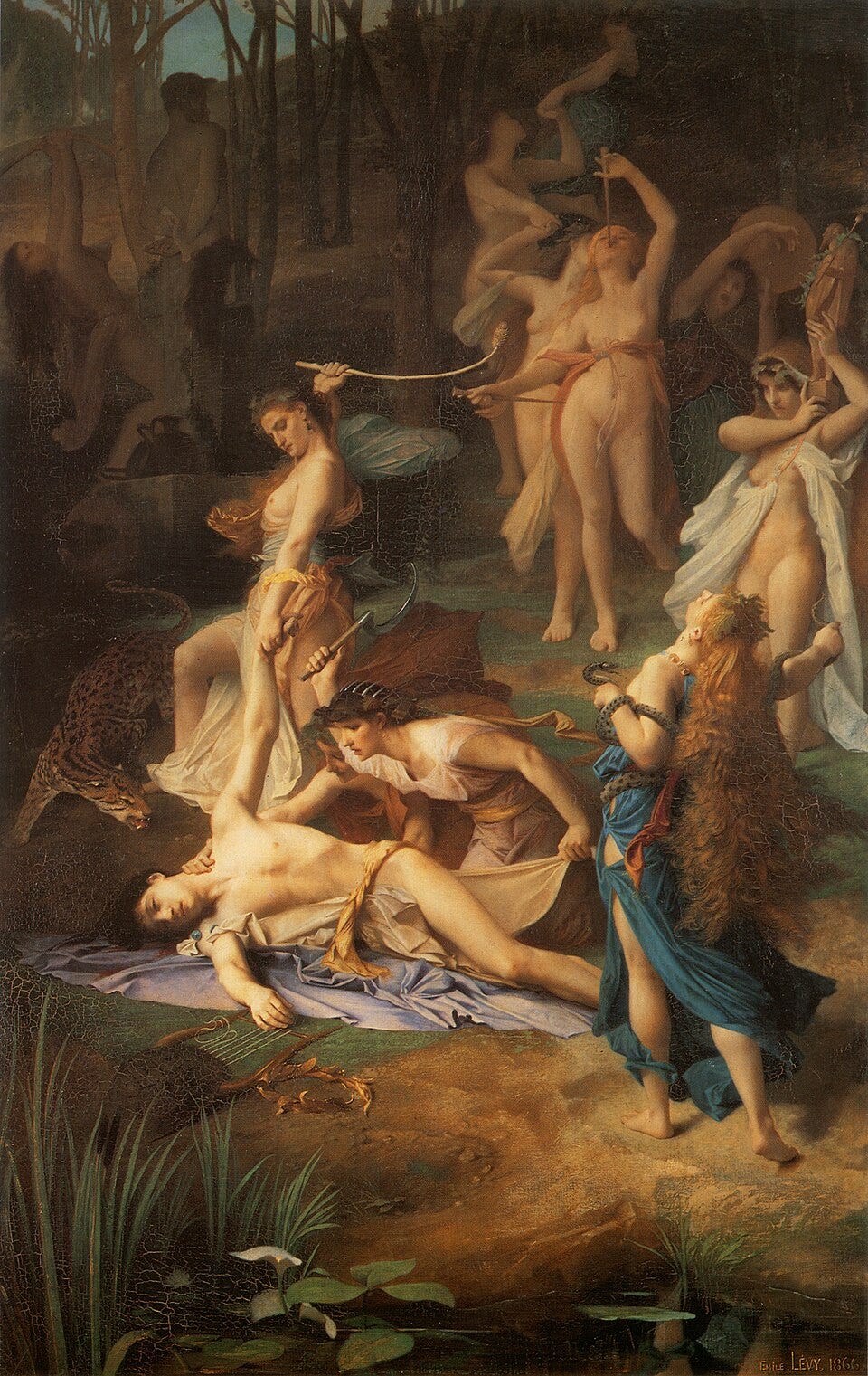
And this brings us back to the fate of Orpheus in Greece. Votaries of Dionysus that they were, did the Maenads tear Orpheus asunder because he would have falsified the earth, converting its miraculous savagery into docile sterility? Could there be anything so degrading and so sad as to see a lion eating straw like an ox or to hear a wolf singing compline with Ciarán? For them no Isaiah. For them the God who spoke to Job out of the whirlwind saying, ‘Behold now behemoth, which I made with thee.’ For them Blake who said:
The roaring of lions, the howling of wolves, the raging of the stormy sea and the destructive sword are portions of eternity too great for the eye of man.
Didn’t Dionysus himself become a lion, didn’t he become a roaring portion of eternity to the pirates who would have restrained and chained him?
Better that than our calamitous biblical ambition to rule over and subdue all things.
It was deliberately not by a slip of His biblical tongue that his biblical God advised Job to abandon this, his biblical ambition:
Canst thou draw out Leviathan with an hook? or his tongue with a cord which thou lettest down? Canst thou put an hook into his nose? or bore his jaw through with a thorn? Will he make many supplications unto thee? will he speak soft words unto thee? Will he make a covenant with thee? wilt thou take him for a servant forever? Wilt thou play with him as with a bird? or wilt thou bind him for thy maidens? Shall the companions make a banquet of him? shall they part him among the merchants? Canst thou fill his skin with barbed irons? or his head with fish spears? Lay thine hand upon him, remember the battle, do no more. Behold the hope of him is in vain: shall not one be cast down even at the sight of him?
Amhairghin’s six questions.
Yahweh’s fifteen questions.
Were Yahweh’s fifteen questions the fifteen planks of the boat that St Fiónán and his monks sailed to Scelec in?
St Ciarán and St Fiónán, the one founding a monastery inland in Saighir, the other founding his monastery offshore on Scelec.
Is it inevitable that Christianity inland will be different from Christianity offshore? As different as the mellow voice of a blackbird from the mind-slicing scream of a gannet?
Not by a slip of the tongue but in a deliberate act of piety, can we say
Crab of God
Shark of God
Gannet of GodAs Native Americans would, can we be Christian crab-dreamers, Christian shark-dreamers, Christian gannet-dreamers, Christian behemoth-dreamers, Christian Leviathan-dreamers, crab and shark and gannet and behemoth and Leviathan giving us the medicine of not being superior to the one world soul.
…
In Ollamh Fódhla we are still seeking to reach Ireland.
As we are in Conaire Mór walking naked to Tara, that is the hill of everyone’s royalty.Wolves seeking to lead him one way, wild horses another, the quest continues in Cormac mac Airt.
Splendid in himself and splendid as image and instance of what is royal, of what is regal, of what is sovereign in every one of us, Cormac was one day standing on the rampart wall in Tara. He saw a sovereign lady coming towards him. She challenged him to a game of fidchel.
‘What,’ Cormac asked, ‘is the wager?’
‘That you will know,’ she replied, ‘only when you have won it or lost it.’Cormac lost, and with that he found his sense of his royalty fading from him. While a glimmer of it yet remained to him, he commanded that his horses be yoked to his chariot. He rode south through the now desolate land. He crossed into another way, a perfect way, of seeing and knowing the world. The house he came to was perfect. It was thatched with feathers, no feather ruffled, all of them lying as perfectly layered upon it as his fidchel board, the pieces set, was the sovereign lady. Cormac won, and with that, to his surprise, he recovered his sense of his royalty.
‘You were absent,’ his wife said to him that night.
‘I have suffered what will happen to people in Ireland in time to come,’ Cormac said. ‘They will lose their sense of their royalty. They won’t know what Tara means. Their horses won’t know the way to another way, to the perfect way, of seeing and knowing the world.’